
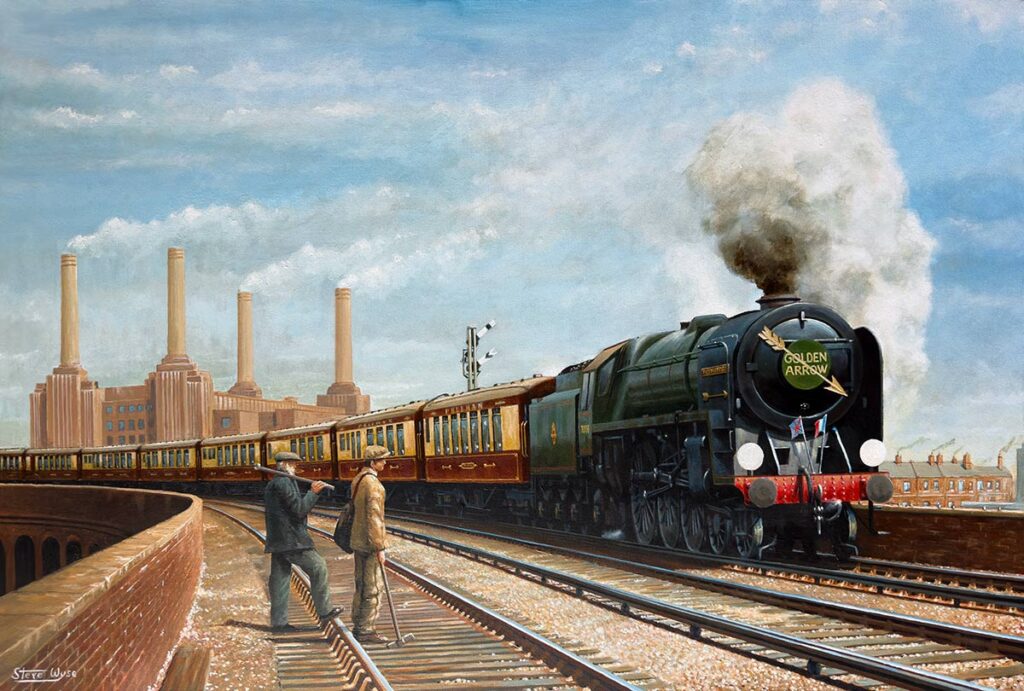
British Railways Britannia class pacific No. 70004 ‘William Shakespeare’ passes Battersea Power Station and nears Factory Junction with the ‘Golden Arrow’ Pullman boat train in late 1955.
No. 70004 ‘William Shakespeare’ was one of a pair of Britannia class locomotives allocated to Stewarts Lane, the other being No. 70014 ‘Iron Duke’. Both engines were to be transferred away in 1958.
Before WWII the Golden Arrow was worked by Lord Nelson class locos and occasionally King Arthur 4-6-0s. Following WWII the first locomotives the haul the train were Bulleid pacifics, but from 1953 until 1958 British Railways standard class 7 engines number 70004 ‘William Shakespeare’ and number 70014 ‘Iron Duke’ performed the honours, before the Bulleid engines returned until electrification of the South East Kent mainline in June 1961.
History of The Golden Arrow
In a short period of time aided by smart marketing and promotion the combined Golden Arrow/Flèche d’Or service (a product of two railway companies – the Southern and Nord) became one of the world’s best known luxury trains. The train/boat/train service had its own dedicated first-class only steamer crossing the channel between Dover and Calais – the TSS Canterbury being the pride of Southern Railway’s fleet. In July 1930 the Golden Arrow was appointed with eight renovated umber and cream art deco Pullman cars Adrian, Diamond, Ibis, Lady Dalziel, Lydia, Onyx, Pearl and Princess Elizabeth. The exotic Golden Arrow became famous for its personalised service and haute cuisine menus frequented by society’s well-heeled classes.
The rather grandiose start unfortunately was not to last as darkening economic clouds downgraded the Golden Arrow from its exclusive first-class Pullman status. The train then accommodating first and second-class passengers together with Pullman first-class passengers. Conditions on the Continent were no better forcing the French to make a similar response to their CIWL Pullman operation. Cross-channel passenger traffic plummeted with total journeys taken nearly halving in 1932 against a long-trend average of 1,000,000 over the years 1925 to 1930. In the period 1933 to 1935 a recovery recommenced to an average 1,125,000 passengers per annum crossing the channel by train/boat/train. By the summer of 1937 the number of continental passengers had recovered to the long-term trend with Saturday 31st July experiencing an all-time high of 22,828 passengers for the day, requiring 50 additional boat train workings. Until recovery the look and composition of the multi-class Golden Arrow changed typically made up of three to four Pullman coaches located in the middle of the train with one or more luggage trucks and general utility vans at one end with a mix of ordinary coaches at the other end. In 1938 the Maunsell first class rake was upgraded and renovated with new upholstery and sported a new Southern Railway Olive green livery. Four Lord Nelson 4-6-0 locomotives regularly used on the service were also repainted in olive green providing the Golden Arrow with a much needed facelift.
Post-war Southern Railway made strenuous efforts to run a luxury train service again making the Golden Arrow a first and second-class all-Pullman service whilst running a separate train to carry other first and second-class passengers. A ‘Golden Arrow’ insignia was carried on locomotive sides, a specially devised headboard together with Anglo-French flags. This promotional initiative coincided with the deployment of the new dedicated Golden Arrow steamer Invicta. The all-Pullman Golden Arrow was now made up of ten coaches with three second-class Pullmans – two parlours cars and a brake parlour – being converted and renumbered together with three first-class kitchen cars, two parlour cars, a brake parlour and a new product innovation – the Trianon Bar car. The ideas for a dedicated bar car had stemmed from CIWL’s luxury Blue Train French Riviera service but also led to BR(S) later experimenting by creating a ‘Tavern coach’ made up of new Bulleid stock used on many longer-distance commuter services. In May 1947 Golden Arrow was made a first-class Pullman service only but the composition again changed in October 1949 when second-class Pullmans were reintroduced.
On 11th June 1951 coinciding with the Festival of Britain celebrations the Golden Arrow received another significant make-over with the introduction of seven newly built first class Pullman cars (being part of a suspended pre-war order) and three rebuilt second-class cars making Golden Arrow a truly luxurious train again headed by new Britannia class locomotives. There were some minor changes to the Pullman composition but the overall ten car provision continued throughout the 1950s. This period was really the pinnacle of the Golden Arrow but it was not to last because of regular and reliable air services between Britain and France and the increasing fashion to take the car to France on roll-on roll-off ferries – many operated by British Railways. These changes in consumer choice started to nibble away at the edges of the luxury train service.
The Golden Arrow was always deemed a luxury boat train service and for most of its operational life it was well supported by its railway masters on both sides of the water. Electrification changed the nature of the Golden Arrow, the glamour of the Golden Arrow gave way to the dull but efficient monotony of electric traction. On the other hand electrification provided a speeded up service to the coast but the train had lost its personality. Second-class Pullmans were removed in the 1960s. The Golden Arrow then became a train of first-class Pullman stock and standard MK1 second class coaches.
It was only in the final years that BR and SNCF began to view the service as anachronism and a relic of a bye gone age. In 1968 BR decided to give the Golden Arrow one final chance with a livery change where the Pullman cars were repainted in corporate blue and grey. The Golden Arrow name on the lower blue panel replaced the coach name and class designation and car numbers appeared at coach ends. With this makeover the Pullman had lost its unique branding but passengers found it difficult to differentiate the vehicles. A total of six Pullmans – two kitchen cars, three parlours and a parlour brake – formed part of the Golden Arrow which was hauled in its final years by blue liveried class 71 third rail DC electric locomotives.
In France the Flèche d’Or having lost its Pullman cars in 1969 suffered a similar fate of railway modernisation. In Britain the end of the Golden Arrow came on 30 September 1972; Continental travel would become less glamorous with its demise but the memory of the Golden Arrow as one of Britain’s most famous luxury named-trains lives on.
Original painting is for sale. Acrylics on canvas, 34″ x 23″ unframed. enquiries to steve.wyse@artwyse.com
Prints are available >> golden-arrow-battersea-1955